
Cricket odds explained: decimal odds, probability and value
Quick answer
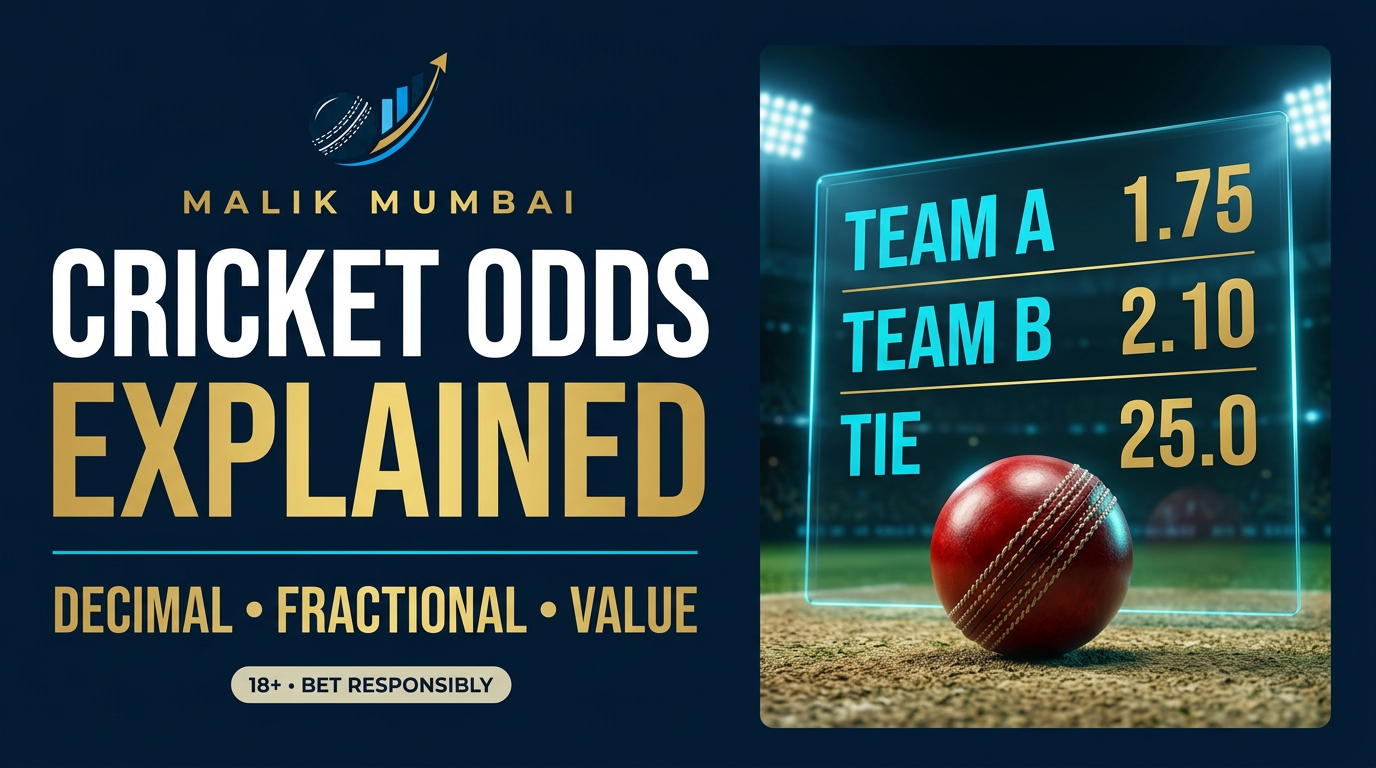
Cricket odds are the prices next to match winner, toss, session and player markets. Decimal odds show your total return per rupee staked, and dividing 1 by the odds gives the implied probability. A price is only worth taking when your own estimate of the chance is higher than the price implies.
Key takeaways
- How do decimal odds work? Decimal odds show your total return per ₹1 staked, including the stake.
- How do you turn odds into a probability? Divide 1 by the decimal odds.
- When is a price worth taking? Only when your own estimate of the chance is higher than the price implies.
- Which markets do people mix up? Toss odds are settled at the toss.
- How do accumulator odds add up? Multiply the odds of each leg.
How do decimal odds work?
Decimal odds show your total return per ₹1 staked, including the stake. A ₹100 bet at 1.80 returns ₹180 if it wins, which is ₹80 profit. A ₹100 bet at 2.50 returns ₹250, or ₹150 profit. The bigger the number, the less likely the bookmaker thinks the result is.
| Decimal odds | Implied chance | Return on ₹100 | Profit |
|---|---|---|---|
| 1.50 | 66.7% | ₹150 | ₹50 |
| 1.80 | 55.6% | ₹180 | ₹80 |
| 2.00 | 50.0% | ₹200 | ₹100 |
| 2.10 | 47.6% | ₹210 | ₹110 |
| 2.50 | 40.0% | ₹250 | ₹150 |
| 4.00 | 25.0% | ₹400 | ₹300 |
How do you turn odds into a probability?
Divide 1 by the decimal odds. A price of 1.80 implies about a 55.6% chance, and 2.10 implies about 47.6%. Add the two sides of a match together and you get 103.2%, not 100%. The extra 3.2% is the bookmaker's margin, which is why backing both teams at those prices loses money whatever happens.
When is a price worth taking?
Only when your own estimate of the chance is higher than the price implies. If you think a team wins 60% of the time and the odds are 1.80 (55.6%), the price is in your favour. If you think it's 50%, the same price is poor value, even if that team is the favourite.
Being right about who wins isn't enough; the price has to be right too.
Which markets do people mix up?
- Toss odds are settled at the toss.
- Match-winner odds keep moving after the toss and throughout the chase.
- Session odds are a separate market from match winner.
- Player odds depend on the real XI.
How do accumulator odds add up?
Multiply the odds of each leg. Three legs at 1.50, 1.60 and 1.70 combine to 4.08. The chances multiply too: three results that are each about 60% likely all come in only about 22% of the time. Each extra leg also stacks the bookmaker's margin, which is why long accumulators rarely pay off.
Compare IPL title prices on our IPL odds page.
Frequently asked questions
Short answers to the questions this guide raises most.
What does odds of 2.00 mean?
A ₹100 stake returns ₹200 if it wins, so ₹100 profit. It implies about a 50% chance before the margin.
How do I work out implied probability?
Divide 1 by the decimal odds. 1 ÷ 1.80 is about 0.556, or 55.6%.
What is the bookmaker's margin?
The amount by which both sides' implied chances add up to more than 100%. It's the bookmaker's built-in edge.
How do cricket accumulator odds work?
Multiply each leg's odds. Every leg can fail, so more legs mean more ways to lose.
Still unsure? Ask our team
Sources and official references
Check rules, fixtures and figures with the bodies that publish them.
- Playing conditions for international cricketInternational Cricket Council
- Scorecards, records and ground statisticsESPNcricinfo
- ICC team and player rankingsInternational Cricket Council
- House edge and game probability tablesWizard of Odds
- Tele-MANAS free mental health helpline (14416)Ministry of Health and Family Welfare
18+ only. Betting carries real financial risk and no tip or guide guarantees a result. Check the law where you live, and read our responsible gambling guide if betting stops being fun.
About the author
Rohan MehtaHead of Cricket
Ten years covering domestic and international cricket. Leads our T20 Premier Cup coverage and records every pick publicly.
More from Rohan →Related reading

Betting Basics
Probability in sports betting: what the price is telling you
What betting odds say about probability: why short prices can lose, how to read the return on your slip, why accumulators tempt and what live prices mean.
· 2 min read

Cricket
Cricket betting guide: markets, conditions, odds and bankroll
A complete cricket betting guide: the main markets, how format, pitch and weather move prices, how to read decimal odds, and how to manage a betting bankroll.
· 2 min read

Cricket
Cricket betting market types, plus lagai, khai and lambi explained
Every common cricket betting market explained, plus the Indian terms lagai, khai, session and lambi, what fancy means and which market suits your view.
· 3 min read